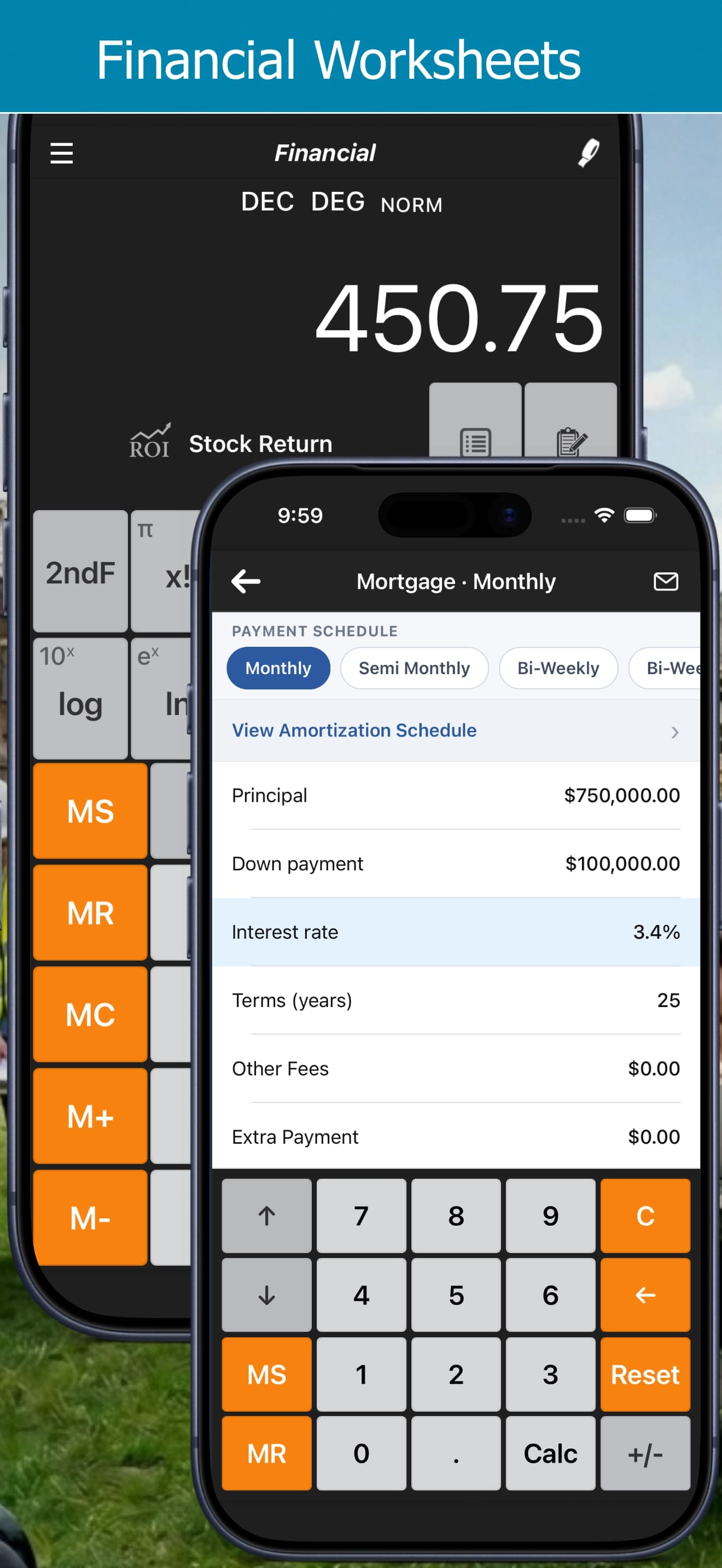
Financial Calculator Guide: All 23 Worksheets Explained
Learn Calc Pro's 23 financial worksheets, from mortgages, loans and TVM to retirement, bonds and options, with worked examples.
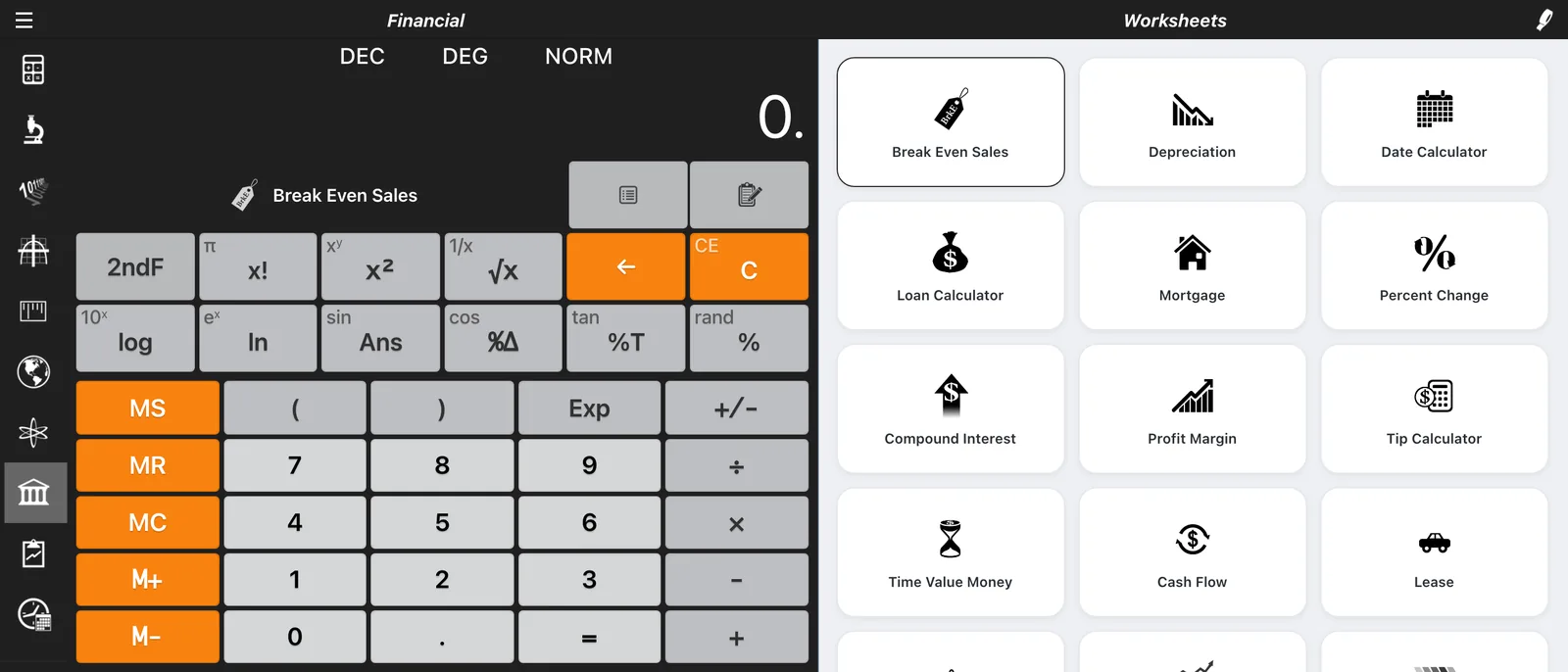
Calc Pro's Financial Calculator is a comprehensive suite of 23 specialized worksheets covering everything from basic loan calculations to complex investment analysis. Whether you're a finance professional, business owner, or someone planning major purchases, this guide will help you master every worksheet.
Overview
The Financial Calculator features:
- 23 specialized worksheets: 9 included free, and 14 more with Pro Premium in the iPhone & iPad app
- PDF and e-mail export (Pro Premium)
- Professional-grade calculations
- Easy-to-use interfaces
- Instant results
The 23 Financial Worksheets
| Included free | Pro Premium |
|---|---|
| Mortgage, Loan, Compound Interest, Depreciation, Date Calculator, Profit Margin, Tip, Break-Even, Percent Change | Time Value of Money, Cash Flow (NPV & IRR), Lease, Retirement Savings, Savings Goal, Credit Card Payoff, Inflation, Bond, Stock Return, Average Cost (DCA), Dividend Income, Options Profit/Loss, Black-Scholes, Position Size |
1. TVM (Time Value of Money) — Pro Premium
The foundation of all financial calculations. Solve for any variable when you know the other four:
| Variable | Symbol | Description |
|---|---|---|
| N | n | Number of periods |
| I/Y | i | Interest rate per year |
| PV | pv | Present value |
| PMT | pmt | Payment per period |
| FV | fv | Future value |
Example: Calculate Monthly Payment
You're buying a car for $25,000 with 5% APR for 60 months:
- N = 60 (months)
- I/Y = 5% (annual rate)
- PV = -25,000 (amount borrowed)
- FV = 0 (paid off at end)
- Solve for PMT = $471.78
Example: How Much Can You Borrow?
You can afford $1,500/month for 30 years at 6.5% APR:
- N = 360 (30 years × 12 months)
- I/Y = 6.5%
- PMT = -1,500
- FV = 0
- Solve for PV = $237,347 (how much you can borrow)
2. Mortgage Worksheet
Try it free in your browser: Mortgage Calculator
Specialized for home loan calculations:
| Field | Description |
|---|---|
| Loan Amount | Principal borrowed |
| Interest Rate | Annual percentage rate |
| Term | Loan length (years) |
| Payment | Monthly payment |
| Extra Payment | Additional principal |
Example: Calculate Mortgage Payment
$400,000 home, 6.5% rate, 30-year term:
- Monthly Payment: $2,528.27
- Total Interest: $510,177.95
Payment schedules: Choose monthly, semi-monthly, bi-weekly, weekly or bi-monthly payments, each with an accelerated option that pays the loan off faster.
Impact of Extra Payments:
Adding $200/month extra:
- Loan paid off 67 months (about 5½ years) sooner
- Save $111,891.54 in interest!
See the Mortgage Calculator guide for accelerated bi-weekly and weekly schedules.
3. Loan Worksheet
Try it free in your browser: Loan Calculator
For general loan calculations:
| Field | Description |
|---|---|
| Principal | Amount borrowed |
| Rate | Interest rate (APR) |
| Term | Loan length |
| Payment | Periodic payment |
Example: Personal Loan
Borrow $10,000 at 8% for 3 years:
- Monthly Payment: $313.36
- Total Paid: $11,281
- Total Interest: $1,281
Amortization Schedules — Pro Premium
From the Mortgage worksheet, tap View Amortization Schedule to see every payment:
| Column | Description |
|---|---|
| Payment # | Payment sequence |
| Payment | Total payment amount |
| Principal | Portion to principal |
| Interest | Portion to interest |
| Balance | Remaining balance |
Understanding Amortization:
Early payments are mostly interest. Over time, more goes to principal:
| Payment | Principal | Interest | Balance |
|---|---|---|---|
| 1 | $361 | $2,167 | $399,639 |
| 180 | $951 | $1,577 | $290,237 |
| 360 | $2,514 | $14 | $0 |
Based on $400,000 at 6.5% for 30 years
4. Depreciation
Calculate asset depreciation using multiple methods:
Straight-Line Method
Equal depreciation each year:
- Depreciation = (Cost - Salvage) / Life
Example:
- Equipment cost: $50,000
- Salvage value: $5,000
- Useful life: 10 years
- Annual depreciation: $4,500
Declining Balance Method
Accelerated depreciation:
- Higher depreciation early
- Decreases over time
Sum-of-Years-Digits Method
Another accelerated method based on remaining life.
5. Compound Interest
Try it free in your browser: Compound Interest Calculator
Calculate compound growth:
A = P(1 + r/n)^(nt)
| Variable | Description |
|---|---|
| P | Principal (starting amount) |
| r | Annual interest rate |
| n | Compounding frequency |
| t | Time in years |
| A | Final amount |
Example: Savings Growth
$10,000 at 5% compounded monthly for 10 years:
- Final Value: $16,470.09
- Interest Earned: $6,470.09
Compounding Frequency Comparison:
$10,000 at 5% for 10 years:
| Frequency | Final Amount |
|---|---|
| Annually | $16,288.95 |
| Quarterly | $16,386.16 |
| Monthly | $16,470.09 |
| Daily | $16,486.65 |
| Continuous | $16,487.21 |
6. Date Calculator
Try it free in your browser: Date Calculator
Calculate dates for financial planning:
| Function | Description |
|---|---|
| Days Between | Days between two dates |
| Add Days | Future date calculation |
| Business Days | Exclude weekends/holidays |
Example: Loan Maturity
Loan starts January 15, 2025, with 90-day term:
- Maturity Date: April 15, 2025
7. Profit Margin
Try it free in your browser: Profit Margin Calculator
Calculate business profitability:
| Metric | Formula |
|---|---|
| Gross Margin | (Revenue - Cost) / Revenue |
| Markup | (Revenue - Cost) / Cost |
| Net Margin | Net Income / Revenue |
Example: Retail Pricing
Product cost: $60, selling price: $100:
- Gross Margin: 40%
- Markup: 66.7%
8. Tip Calculator
Try it free in your browser: Tip Calculator
Calculate tips and split bills:
| Field | Description |
|---|---|
| Bill Amount | Pre-tip total |
| Tip Percentage | 15%, 18%, 20%, custom |
| Split | Number of people |
Example:
$120 dinner, 20% tip, 4 people:
- Tip: $24
- Total: $144
- Per Person: $36
9. Break-Even Analysis
Determine when a business becomes profitable:
Break-Even = Fixed Costs / (Price - Variable Cost)
Example: Product Launch
- Fixed costs: $50,000
- Price per unit: $25
- Variable cost: $10
- Break-Even Point: 3,334 units
10. Percent Change
Calculate percentage increases and decreases:
| Calculation | Formula |
|---|---|
| Percent Change | ((New - Old) / Old) × 100 |
| New Value | Old × (1 + Rate) |
| Old Value | New / (1 + Rate) |
Example: Price Increase
Price went from $80 to $95:
- Percent Change: 18.75% increase
11. Cash Flow (NPV & IRR) — Pro Premium
Evaluate an investment from the money it pays back over time.
- You enter: Initial Investment, each period's Cash Flow, and a Discount Rate
- You get: Net Present Value (NPV) and Internal Rate of Return (IRR)
A positive NPV at your required rate of return means the investment is worth more than it costs.
12. Lease — Pro Premium
Work out the true cost of leasing a car or equipment.
- You enter: Price, Down Payment, Trade-In, Residual Value, Interest Rate, Number of Months, Sales Tax and Other Fees
- You get: Monthly Payment, Total Payments, Total Interest, Total Tax and Total Depreciation
13. Retirement Savings — Pro Premium
Try it free in your browser: Retirement Calculator
See whether you're on track for retirement.
- You enter: Current Savings, Annual Contribution, Growth Rate, Years to Retirement, Years in Retirement, and the growth rate you expect during retirement
- You get: your balance at retirement, Total Contributions, Total Earnings, and the Annual Income your savings can provide
14. Savings Goal — Pro Premium
Try it free in your browser: Savings Goal Calculator
Find out how much to save each month to reach a target.
- You enter: your Savings Goal, Current Savings, Annual Rate and Years
- You get: the Monthly Deposit Needed, Total Deposits and Interest Earned
15. Credit Card Payoff — Pro Premium
Try it free in your browser: Credit Card Payoff Calculator
- You enter: Balance, APR and Monthly Payment
- You get: Months to Pay Off, Total Interest and Total Paid
If the payment doesn't cover the monthly interest, Calc Pro tells you the balance will never be paid off.
16. Inflation — Pro Premium
Try it free in your browser: Inflation Calculator
- You enter: an Amount Today, the Inflation Rate and a number of Years
- You get: the Future Cost, Total Increase, and the future Purchasing Power of today's money
17. Bond — Pro Premium
- You enter: Face Value, Coupon Rate, coupons per year (annual, semi-annual or quarterly) and Years to Maturity
- You get: the Bond Price from a yield, or the Yield to Maturity from a price, plus the Current Yield
18. Stock Return — Pro Premium
- You enter: Shares, Buy Price, Sell Price, Commissions and Days Held
- You get: Gain/Loss, Return, Annualized return and Break-Even Price
19. Average Cost (DCA) — Pro Premium
Buying more of a stock you already own? See your new average cost.
- You enter: Current Shares, Current Average Cost, New Shares and New Price
- You get: New Average Cost, Total Shares and Total Invested
20. Dividend Income — Pro Premium
- You enter: Shares, Share Price, Annual Dividend, Dividend Growth, Years, and whether to reinvest dividends
- You get: Current Yield, Annual Income, Total Dividends, Final Shares and Income in the Final Year
21. Options Profit/Loss — Pro Premium
Model four common strategies: Long Call, Long Put, Covered Call and Cash-Secured Put.
- You enter: Strike Price, Premium, Contracts, Stock Buy Price (for covered calls) and Price at Expiry
- You get: Profit/Loss, Max Gain, Max Loss and Break-Even Price
22. Black-Scholes Option Pricer — Pro Premium
- You enter: Call or Put, Stock Price, Strike Price, Days to Expiry, Volatility, Risk-Free Rate and Dividend Yield
- You get: the theoretical Option Price and the Greeks: Delta, Gamma, Theta (per day) and Vega
23. Position Size — Pro Premium
Size a trade so you only risk what you mean to.
- You enter: Account Size, Risk Percent, Entry Price and Stop Loss
- You get: Shares to Buy, Amount at Risk and Position Cost
Export Your Worksheets — Pro Premium
Save or e-mail any worksheet as a PDF to share with a lender, a client or your accountant.
Practical Scenarios
Scenario 1: Home Buying Decision
Question: Can you afford a $450,000 home?
Using the Mortgage Worksheet:
- Enter $450,000 loan amount
- Enter current rate (e.g., 6.5%)
- Enter term (30 years)
- Result: $2,844/month
Include taxes and insurance (~25% of payment):
- Total monthly: ~$3,555
General rule: Housing should be ≤28% of gross income.
Required income: $3,555 × 12 / 0.28 = $152,357/year
Scenario 2: Investment Growth
Question: How much will $500/month grow in 30 years?
Using TVM:
- N = 360 months
- I/Y = 7% (average market return)
- PV = 0
- PMT = -500
- FV = $566,765
You contributed $180,000; growth added $386,765!
Scenario 3: Debt Payoff Strategy
Question: Pay off credit card faster
$10,000 balance at 22% APR:
Minimum payments (~$200/month):
- Time to payoff: 9.5 years
- Total interest: $12,772
Aggressive payments ($500/month):
- Time to payoff: 2 years
- Total interest: $2,235
- Savings: $10,537!
Scenario 4: Business Equipment Decision
Question: Buy or lease equipment?
Option A: Buy for $100,000
Using Depreciation:
- 7-year straight-line
- Annual depreciation: $14,286
- Tax savings: $14,286 × tax rate
Option B: Lease for $18,000/year
- Fully deductible expense
- No ownership at end
Calculate net present value of each to compare.
Scenario 5: Retirement Planning
Question: Are you on track for retirement?
Current savings: $250,000
Years to retirement: 20
Monthly contribution: $1,000
Expected return: 7%
Using TVM:
- N = 240 months
- I/Y = 7%
- PV = -250,000
- PMT = -1,000
- FV = $1,493,684
At 4% withdrawal rate: $59,747/year income
Financial Formulas Reference
Time Value of Money
FV = PV(1 + r)^n
PV = FV / (1 + r)^n
Annuity Formulas
FV of Annuity = PMT × ((1 + r)^n - 1) / r
PV of Annuity = PMT × (1 - (1 + r)^-n) / r
Loan Payment
PMT = PV × (r(1 + r)^n) / ((1 + r)^n - 1)
Compound Interest
A = P(1 + r/n)^(nt)
Effective Annual Rate
EAR = (1 + r/n)^n - 1
Tips for Financial Calculations
1. Match Time Periods
If your rate is annual and payments are monthly:
- Divide rate by 12
- Multiply years by 12
2. Watch Your Signs
- Money you pay out: negative (-)
- Money you receive: positive (+)
3. Check Reasonableness
Does your answer make sense? A 30-year mortgage payment should be much less than the total loan.
4. Consider All Costs
Loans often have:
- Origination fees
- Closing costs
- Insurance requirements
5. Account for Inflation
Future values are nominal dollars. Real purchasing power depends on inflation.
Professional Applications
Real Estate
- Mortgage comparisons
- Investment property analysis
- Rent vs. buy decisions
Banking
- Loan structuring
- Interest calculations
- Payment schedules
Corporate Finance
- Capital budgeting
- Depreciation schedules
- Break-even analysis
Personal Finance
- Retirement planning
- Debt payoff strategies
- Savings goals
Deep-Dive Guides
- Mortgage Calculator: payment schedules, extra payments and amortization
- Retirement and Savings Planning: retirement, savings goals and inflation
- Investing and Options: stock returns, dividends, bonds, options and Black-Scholes
Conclusion
Calc Pro's Financial Calculator provides all the tools you need for sound financial decision-making. From everyday tip calculations to complex investment analysis, these 23 worksheets cover the full spectrum of financial calculations.

Calc Pro
4.6 · 4,712 ratingsPut the Financial Calculator to work
Use it free in your browser right now, or take Calc Pro with you on iPhone and iPad.
Take it with you


 Coming soon
Free with ads · In-app purchase unlocks the full Pro Premium version