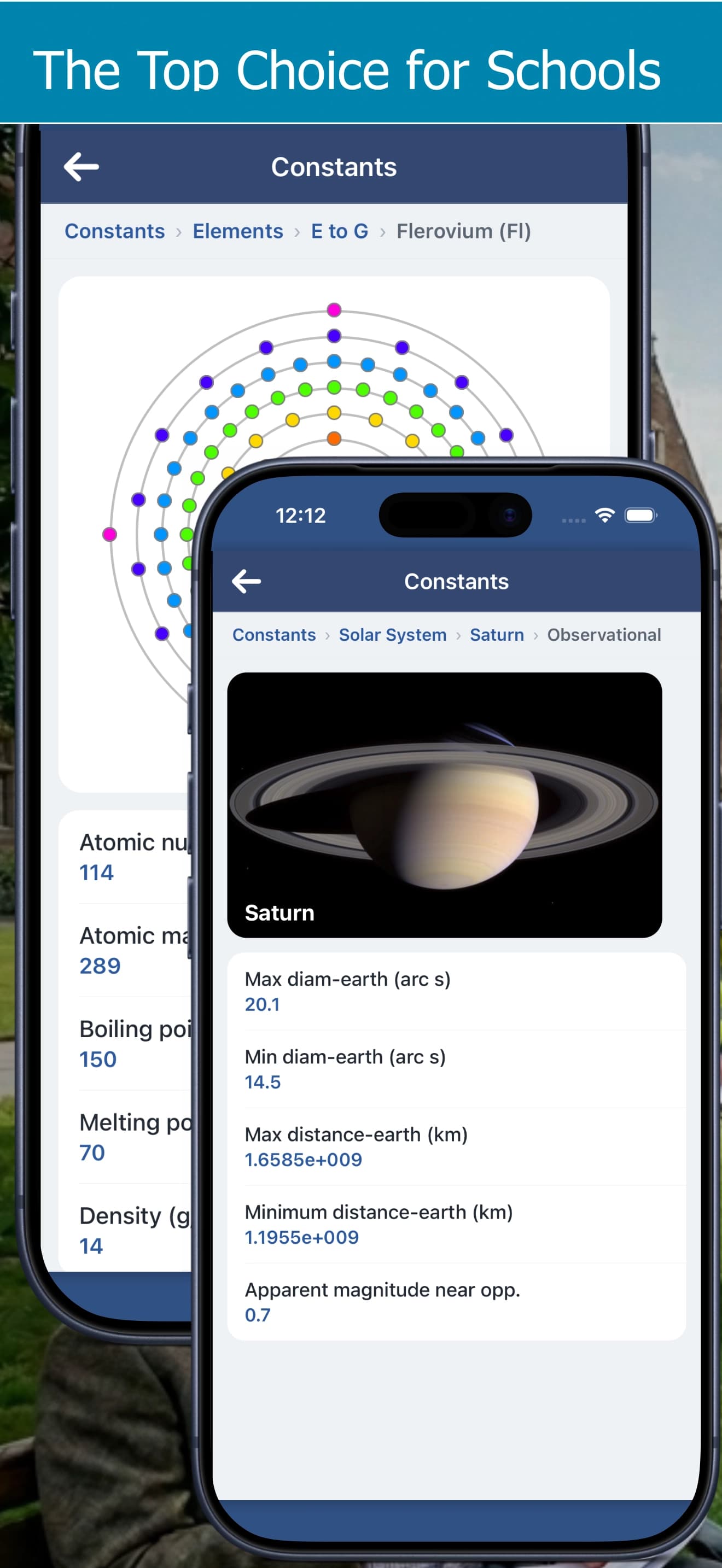
Scientific Constants Guide: Nearly 2,000 Math and Science Constants
Look up and use nearly 2,000 constants, from π and the speed of light to planetary data and the elements, with Calc Pro's constants library.
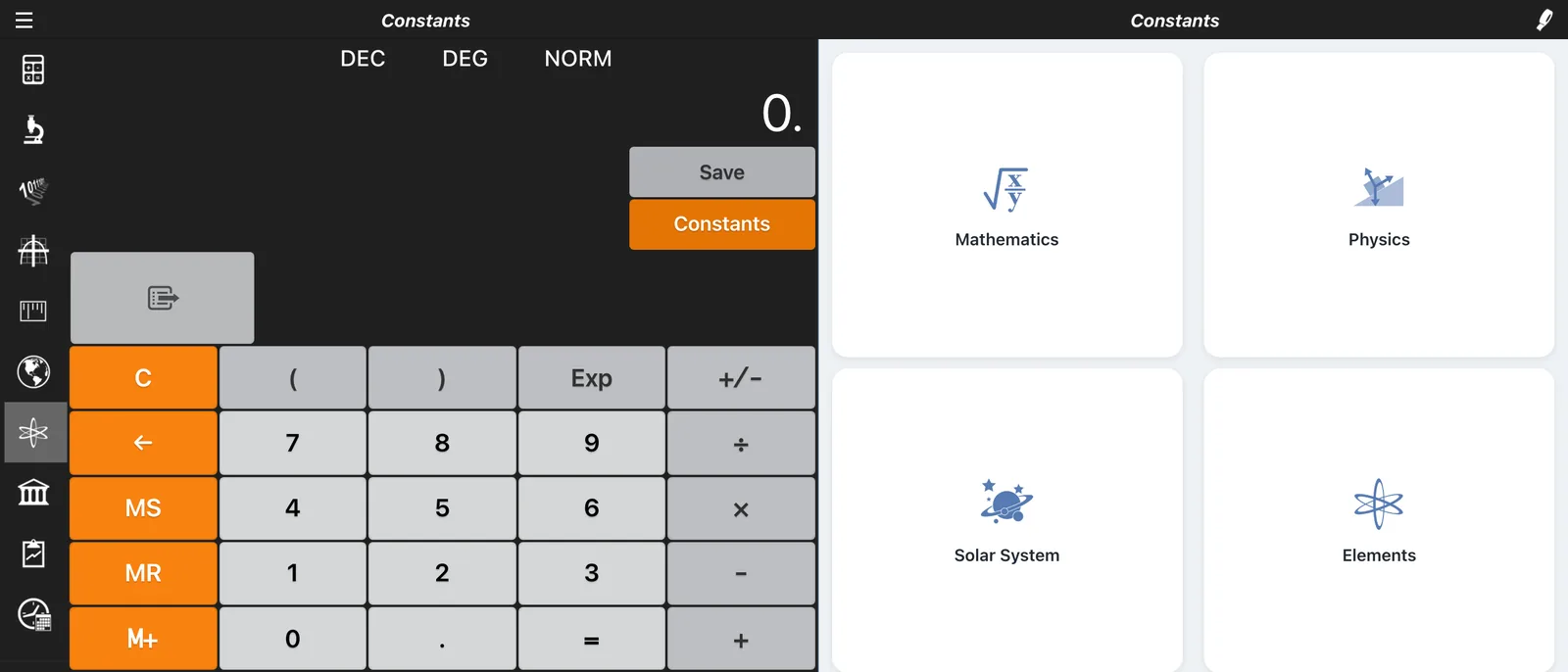
Calc Pro's Constants Calculator is a comprehensive reference library putting essential mathematical, physics, chemistry, and astronomical constants at your fingertips. No more searching textbooks or websites—every constant you need is just a tap away.
Overview
The Constants Calculator features:
- Nearly 2,000 constants in 9 categories
- Full precision values with units
- Easy insertion into calculations
- Comprehensive descriptions for each constant
Constant Categories
Constants are organized into nine top-level categories. Mathematics, Physics, Solar System and Elements are included free. Chemistry, Biology, Engineering, Computer Science and Earth Science unlock with Pro Premium in the iPhone & iPad app (see section 8). The Physics category is divided into groups such as Universal, Electromagnetic, Atomic and Nuclear, and Physico-chemical constants, covered in sections 2–5.
1. Mathematical Constants
These fundamental numbers appear throughout mathematics:
| Constant | Symbol | Value | Description |
|---|---|---|---|
| Pi | π | 3.14159265358979... | Ratio of circumference to diameter |
| Euler's number | e | 2.71828182845904... | Base of natural logarithms |
| Golden ratio | φ | 1.61803398874989... | (1 + √5) / 2 |
| Square root of 2 | √2 | 1.41421356237309... | Diagonal of unit square |
| Square root of 3 | √3 | 1.73205080756887... | Height of equilateral triangle |
| Natural log of 2 | ln(2) | 0.69314718055994... | Time to double at 100% growth |
| Natural log of 10 | ln(10) | 2.30258509299404... | Conversion factor for logarithms |
| Euler-Mascheroni | γ | 0.57721566490153... | Limit constant in harmonic series |
2. Universal Physical Constants
Fundamental constants of nature:
| Constant | Symbol | Value | Units |
|---|---|---|---|
| Speed of light | c | 299,792,458 | m/s |
| Gravitational constant | G | 6.67430 × 10⁻¹¹ | m³/(kg·s²) |
| Planck's constant | h | 6.62607 × 10⁻³⁴ | J·s |
| Reduced Planck | ℏ | 1.05457 × 10⁻³⁴ | J·s |
| Boltzmann constant | k | 1.38065 × 10⁻²³ | J/K |
| Stefan-Boltzmann | σ | 5.67037 × 10⁻⁸ | W/(m²·K⁴) |
| Vacuum permittivity | ε₀ | 8.85419 × 10⁻¹² | F/m |
| Vacuum permeability | μ₀ | 1.25664 × 10⁻⁶ | H/m |
3. Atomic & Nuclear Constants
For particle physics and chemistry:
| Constant | Symbol | Value | Units |
|---|---|---|---|
| Elementary charge | e | 1.60218 × 10⁻¹⁹ | C |
| Electron mass | mₑ | 9.10938 × 10⁻³¹ | kg |
| Proton mass | mₚ | 1.67262 × 10⁻²⁷ | kg |
| Neutron mass | mₙ | 1.67493 × 10⁻²⁷ | kg |
| Atomic mass unit | u | 1.66054 × 10⁻²⁷ | kg |
| Avogadro's number | Nₐ | 6.02214 × 10²³ | mol⁻¹ |
| Faraday constant | F | 96485.33 | C/mol |
| Rydberg constant | R∞ | 1.09737 × 10⁷ | m⁻¹ |
| Bohr radius | a₀ | 5.29177 × 10⁻¹¹ | m |
| Fine structure | α | 7.29735 × 10⁻³ | (dimensionless) |
4. Thermodynamic Constants
For heat and energy calculations:
| Constant | Symbol | Value | Units |
|---|---|---|---|
| Gas constant | R | 8.31446 | J/(mol·K) |
| Boltzmann constant | k | 1.38065 × 10⁻²³ | J/K |
| Standard atmosphere | atm | 101,325 | Pa |
| Absolute zero | 0 K | -273.15 | °C |
| Triple point of water | 273.16 | K |
5. Electromagnetic Constants
For electrical and magnetic calculations:
| Constant | Symbol | Value | Units |
|---|---|---|---|
| Speed of light | c | 299,792,458 | m/s |
| Vacuum permittivity | ε₀ | 8.85419 × 10⁻¹² | F/m |
| Vacuum permeability | μ₀ | 1.25664 × 10⁻⁶ | H/m |
| Impedance of vacuum | Z₀ | 376.730 | Ω |
| Coulomb's constant | k | 8.98755 × 10⁹ | N·m²/C² |
6. Solar System Data
Planetary and astronomical constants:
The Sun
| Property | Value | Units |
|---|---|---|
| Mass | 1.989 × 10³⁰ | kg |
| Radius | 696,340 | km |
| Surface temperature | 5,778 | K |
| Luminosity | 3.828 × 10²⁶ | W |
Earth
| Property | Value | Units |
|---|---|---|
| Mass | 5.972 × 10²⁴ | kg |
| Mean radius | 6,371 | km |
| Equatorial radius | 6,378 | km |
| Polar radius | 6,357 | km |
| Surface gravity | 9.807 | m/s² |
| Escape velocity | 11.186 | km/s |
| Orbital period | 365.256 | days |
| Orbital velocity | 29.78 | km/s |
| Distance from Sun | 149.6 × 10⁶ | km |
The Moon
| Property | Value | Units |
|---|---|---|
| Mass | 7.342 × 10²² | kg |
| Radius | 1,737 | km |
| Surface gravity | 1.62 | m/s² |
| Distance from Earth | 384,400 | km |
| Orbital period | 27.32 | days |
Other Planets
Each planet includes:
- Mass
- Radius
- Surface gravity
- Distance from Sun
- Orbital period
- Number of moons
7. Chemical Elements
Reference data for the periodic table:
| Element | Symbol | Atomic # | Atomic Mass |
|---|---|---|---|
| Hydrogen | H | 1 | 1.008 |
| Helium | He | 2 | 4.003 |
| Lithium | Li | 3 | 6.941 |
| Carbon | C | 6 | 12.011 |
| Nitrogen | N | 7 | 14.007 |
| Oxygen | O | 8 | 15.999 |
| Iron | Fe | 26 | 55.845 |
| Copper | Cu | 29 | 63.546 |
| Silver | Ag | 47 | 107.868 |
| Gold | Au | 79 | 196.967 |
| Uranium | U | 92 | 238.029 |
All elements from 1-118 available
8. Specialist Categories — Pro Premium
Five more categories cover the constants students and professionals reach for outside physics:
| Category | Example constants |
|---|---|
| Chemistry | Water molecular weight (18.01528 g/mol), glucose molecular weight (180.15588 g/mol), standard molar volume (22.414 L/mol) |
| Biology | Human genome base pairs (3.2 × 10⁹), neurons in the human brain (8.6 × 10¹⁰), blood pH (7.4) |
| Engineering | Density of steel (7,850 kg/m³), Young's modulus of steel (2.0 × 10¹¹ Pa), horsepower (745.7 W) |
| Computer Science | Kibibyte (1,024 bytes), max signed 32-bit integer (2,147,483,647), machine epsilon (2.22 × 10⁻¹⁶) |
| Earth Science | Astronomical unit (1.496 × 10¹¹ m), height of Mount Everest (8,848.86 m), age of Earth (4.543 × 10⁹ years) |
How to Use Constants
Viewing a Constant
- Open the Constants Calculator
- Select a category (Math, Physics, etc.)
- Browse or search for your constant
- View the full-precision value and units
Using a Constant in Calculations
- Find the constant you need
- Tap to copy/insert the value
- The value is inserted into your calculation
Example: Calculate Photon Energy
Calculate the energy of a photon with wavelength 500 nm:
E = hc/λ
- Get Planck's constant (h): 6.62607 × 10⁻³⁴ J·s
- Get speed of light (c): 299,792,458 m/s
- Wavelength (λ): 500 × 10⁻⁹ m
- Calculate: E = (6.626 × 10⁻³⁴)(3 × 10⁸) / (500 × 10⁻⁹)
- Result: E ≈ 3.98 × 10⁻¹⁹ J
Practical Applications
Physics Problems
Calculate escape velocity:
v = √(2GM/r)
Using:
- G = 6.674 × 10⁻¹¹ m³/(kg·s²)
- M (Earth) = 5.972 × 10²⁴ kg
- r (Earth radius) = 6.371 × 10⁶ m
Result: v ≈ 11.2 km/s ✓
Chemistry Calculations
Molar mass calculations:
- Use atomic masses from elements table
- Water (H₂O): 2(1.008) + 15.999 = 18.015 g/mol
Avogadro calculations:
- Atoms in 12g of carbon = Nₐ = 6.022 × 10²³
Engineering Applications
Electrical calculations:
- Using ε₀ for capacitor design
- Using μ₀ for inductor calculations
- Using c for transmission line impedance
Thermal calculations:
- Stefan-Boltzmann law for radiation
- Boltzmann constant for energy per particle
- Gas constant for ideal gas law
Astronomy
Orbital calculations:
- Use planetary masses and distances
- Calculate orbital periods
- Determine gravitational forces
Example: Moon's orbital velocity
v = √(GM_Earth / r_orbit)
v = √(6.674 × 10⁻¹¹ × 5.972 × 10²⁴ / 3.844 × 10⁸)
v ≈ 1.02 km/s ✓
Categories Quick Reference
When to Use Each Category
| If you need... | Use this category |
|---|---|
| π, e, φ | Mathematical |
| c, G, h | Universal Physical |
| mₑ, mₚ, Nₐ | Atomic & Nuclear |
| R, k, atm | Thermodynamic |
| ε₀, μ₀ | Electromagnetic |
| Planet data | Solar System |
| Atomic masses | Chemical Elements |
| Molecular weights, molar volume | Chemistry (Pro Premium) |
| Genome, cell and body data | Biology (Pro Premium) |
| Material densities, moduli | Engineering (Pro Premium) |
| Byte sizes, integer limits | Computer Science (Pro Premium) |
| Earth and ocean data | Earth Science (Pro Premium) |
Tips for Using Constants
1. Check Units
Always verify the units match your calculation system:
- SI units (meters, kilograms, seconds)
- CGS units (centimeters, grams, seconds)
- Imperial/US units
2. Use Scientific Notation
For very large or small constants, Calc Pro displays and handles scientific notation properly.
3. Significant Figures
Constants are provided to high precision. Round your final answer appropriately for your application.
4. Verify Critical Values
For important calculations, cross-reference with authoritative sources (NIST, CODATA).
5. Temperature Units
Be careful with temperature constants:
- Absolute zero: 0 K = -273.15°C = -459.67°F
- Always use Kelvin for physics calculations
Educational Value
For Students
- Quick reference during homework
- Learn relationships between constants
- Explore units and dimensional analysis
- Verify textbook values
For Teachers
- Classroom demonstrations
- Consistent reference values
- Show constant relationships
For Professionals
- Engineering calculations
- Research reference
- Quick verification
- Consistent precision
Fun Facts About Constants
Pi (π)
- Appears in circles, spheres, waves, and probability
- Calculated to trillions of digits
- March 14 is Pi Day (3/14)
Speed of Light (c)
- Exactly defined as 299,792,458 m/s
- Nothing with mass can reach it
- Foundation of special relativity
Avogadro's Number
- Named after Amedeo Avogadro
- Connects microscopic and macroscopic scales
- Used to define the mole
Golden Ratio (φ)
- Appears in art, architecture, and nature
- Fibonacci sequence ratios approach φ
- Found in spirals and proportions
Conclusion
Calc Pro's Constants Calculator transforms your device into a comprehensive scientific reference. Whether you're solving physics problems, performing chemistry calculations, or exploring astronomy, having precise constant values at your fingertips saves time and ensures accuracy.
Next: Learn about the Financial Calculator for business and investment calculations

Calc Pro
4.6 · 4,712 ratingsPut the Constants to work
Use it free in your browser right now, or take Calc Pro with you on iPhone and iPad.
Take it with you


 Coming soon
Free with ads · In-app purchase unlocks the full Pro Premium version